

I have been a fan of growing Triops for quite some time now, but I will always remember the first kit I used: My Aqua Dragons from Animagic. And this is exactly what we’re going to talk about in today’s article, so that you can decide if you should get one or not.
I am fascinated by building and having small ecosystems (ideally self-sustaining), as I have already showed you in previous articles about Jarrarium Animals, my article on the Best Jars for an Enclosed, Self-sustaining Water Ecosystem or Best Substrate for a Jarrarium.
But one of the easiest micro ecosystems that you can build at home – and which requires minimal care – is a Triops habitat. And although there are many options out there (all of them solid, in my opinion), today we’re talking about Aqua Dragons as it seems to have the highest success rates out of them all..
What are Triops?
I do believe that if you’re here to read my review, you already know the answer to the question above, so you can skip this segment completely. But if you don’t – read on!
Triops longicaudatus (their full, scientific name), are small crustaceans in the tadpole shrimp family. Some of them are considered living fossils, being over 300 million years old. In other words, they have been around when the dinosaurs were roaming the planet!
This makes the tiny crustaceans extremely interesting for both grown-ups and kids: it’s not often that you can actually examine a species that is so old, and especially grow it on your desk at home, with minimal care required.
But despite their long history, Triops don’t live that long: an adult lives, on average, for 90 days and are not really good pets as they are highly predatory and tend to eat any other living being in their aquarium.
Sure, they won’t be able to eat larger fish, but everything else is fair game, making these little beasts fun to have and extremely interesting to rise.
What Comes in the Kit?
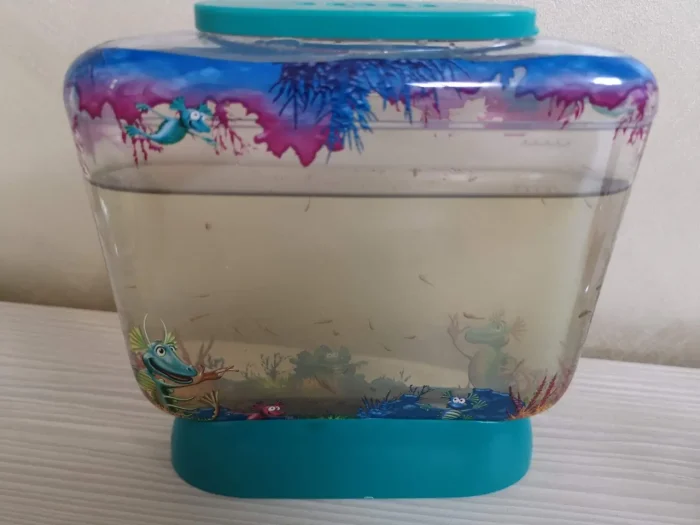
I picked up my Aqua Dragons from Amazon (affiliate link), where it is still the easiest place to order one.
Inside the box you will find a small plastic tank, a clearly written instruction booklet, a sachet of Triops eggs mixed with detritus, a tiny spoon, a pipette, a supply of powdered food, and an adoption certificate. Everything you need to get started is included, right down to the scoop for feeding.
The tank is small, and that might worry anyone who has kept fish before, but Triops in the wild live in temporary puddles that can be just as cramped.
The volume is adequate for a handful of hatchlings, and as I will explain later, nature usually thins the herd on its own.
I hatched my Triops during the summer without any extra heating, but if your room runs cool you will want to pay attention to temperature, which I cover in the setup steps below.
Setup and Hatching Step by Step
The instructions in the booklet are crystal clear, and following them closely virtually guarantees that you will see wriggling larvae within a couple of days.
Here is how my own first run went, plus the tweaks I have since adopted to improve success.
The first and most important step is to use the right water. I originally simply let tap water sit for two days to evaporate the chlorine, which worked for me at the time.
I later learned that many water companies now use chloramine, which does not dissipate as plain chlorine does. So my updated advice is this: either treat tap water with a good aquarium water conditioner that neutralises both chlorine and chloramine (something like Seachem Prime), or use bottled spring water.
Do not use distilled or reverse-osmosis water alone, because Triops need some minerals that regular water has.
Next, even though the booklet advises washing the plastic tank, I forgot to do that. I was sure I had ruined the whole project, but the Triops arrived anyway. Still, it’s probably best to rinse the plastic container with some dechlorinated water first.
I filled the tank with prepared water and poured in the sachet of eggs, which settles into a thin layer on the bottom. The detritus looks like a pinch of dried mud and tiny sticks, and it is where the magic lives.
Temperature matters a lot. Triops eggs need a stable 22-25°C (about 72-77°F) to hatch reliably and to survive.
In the summer months, my room was warm enough, but if your home is cooler, you can position the tank in a warmer spot or, better yet, use a small aquarium heater designed for nano tanks.
Keep the tank out of direct sunlight, though, as the small volume of water can overheat quickly and you will get algae bloom guaranteed.
About 24 hours after adding the detritus, I saw two dot-like creatures twitching in the water. I cannot overstate how happy that moment made me.
Within 48 hours, there were dozens of tiny specks zipping around, and I honestly started to worry that the little tank would not be enough for them all.
Nature has its own plan, though. As the Triops grew, the larger individuals, likely the first to hatch, began preying on the smaller ones.
I believe they ate each other until just two remained. That pair were the original pioneers, and they soon started to grow at an astonishing pace.
Feeding and Daily Care
For the first two or three days, the hatchlings feed on microscopic organisms present in the detritus, so you do not need to add anything.
Once you can clearly see small Triops swimming around, start feeding a tiny pinch of the powdered food provided in the kit every other day – just as instructed by the manual.
A single sachet contains enough for several life cycles, which I discovered the pleasant way when I realised how little they truly need.
Here is a simple feeding schedule that has worked well for me:
- Days 1–3: no added food; they graze on the detritus.
- Day 4 onwards: a very small pinch of the kit food every other day, removing any uneaten particles after a few hours.
Water quality is the main long-term challenge. The tank will start to look murky, which is normal and, honestly, Triops seem to love it.
I perform a partial water change roughly every two weeks by scooping out about 25% of the old water with a clean glass and replacing it with fresh, dechlorinated or spring water.
I am careful not to vacuum the sand bed, because that is where future eggs may be tucked away – and also where the existing triops use to hang out. The muck is part of the habitat, so let it be.
Always keep an eye on the water you remove so you don’t pick up any strays, and make sure to always replace it quickly with same-temperature dechlorinated water. IMPORTANT: They need salted water, so keep this in mind!
One thing the instruction book did not prepare me for was moulting. Triops shed their exoskeleton as they grow.
One morning I found what looked like a perfectly intact Triops lying on the sand and I panicked, certain it had died.
But the little fellow was swimming above it, noticeably larger. They moult regularly, and I remove the shed skin promptly with the pipette to keep the water from fouling.
Here is a video from Youtube showing you the beautiful Triops feeding on some worms (this is how large they get!):
All in all, I was extremely satisfied with the quality of the kit and it was money really well spent.
Even more, with other generations, my son also became extremely interested in the little fellows and he loved to feed them and look at them swim and filter that sand.
So yes, the Aqua Dragons kit does work, it’s easy to set up and extremely easy to care for, providing cheap entertainment and maybe a bit of education too for the entire family.