

There have been all sorts of rumors in the past regarding the origins of Mona Lisa and who was the person that became Leonardo da Vinci’s famous painting. The truth is that nobody really knows for sure, but some of these theories are really interesting and believable.
And one of these theies refuses to die, and I have to admit it is the most fun of the bunch.
It claims that the most famous woman in art history was not a woman at all, but a man: Gian Giacomo Caprotti, nicknamed Salaì, Leonardo da Vinci’s apprentice, companion, and possibly his lover.
I have followed this debate for years, and I am here to tell you everything about it and, most importantly, whether it is true or not. Here is how the whole case fits together, and why the boring answer is probably the right one.
The Short Answer
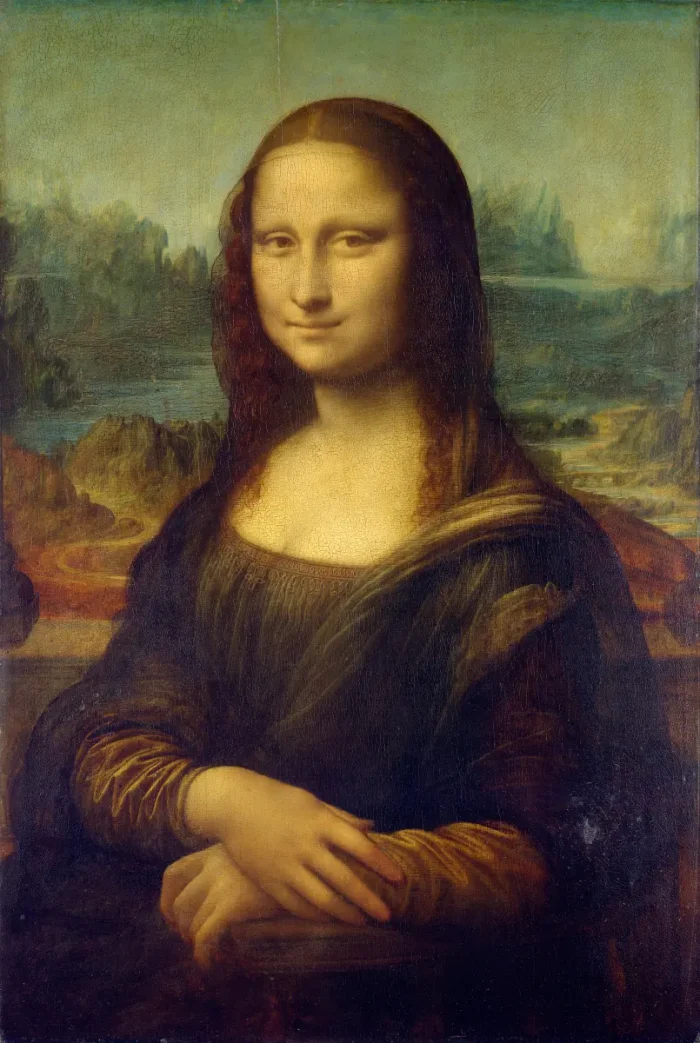
The original Mona List was almost certainly not a man. The sitter was, most likely, Lisa Gherardini, the wife of Florentine silk merchant Francesco del Giocondo, as confirmed by a contemporaneous 1503 document found in Heidelberg in 2005.
The Salaì theory rests on contested claims about tiny hidden letters and facial resemblance, with no documentary support from Leonardo’s lifetime.
Also read: 10 Surprising Facts about Women
Who was Gian Giacomo Caprotti?
Gian Giacomo Caprotti was born around 1480 in Oreno, a village near Milan, and he entered Leonardo’s life in 1490 as a ten-year-old boy, when he became the painter’s apprentice. He then stayed for close to three decades, right up to Leonardo’s final years in France.
Salai was not a professional painting name he adopted, but a nickname, usually translated as “little devil,” and Leonardo himself gave it to him.
If you read Leonardo’s notebooks, you can feel the exasperation on the page. He described the boy as a “thief, liar, obstinate, glutton” and catalogued the money Salai stole from him, along with a running list of lies and minor scandals.
And yet he kept him around, trusted him with practical affairs, remembered him in his will, and, as a rediscovered royal receipt shows, had him facilitate the sale of several paintings to King Francis I of France in 1518. So they certainly had a very complex relationship.
But most likely not to become the face behind Mona Lisa. Sure, by every account, Salai grew into a strikingly beautiful young man in the mold the Renaissance celebrated: slender, graceful, long curly hair, soft and distinctly feminine features.
He modeled for Leonardo repeatedly, too, with the androgynous figure in St. John the Baptist, all curls and that knowing half-smile, is usually identified as him, and the drawing known as Angel Incarnate has been linked to him too.
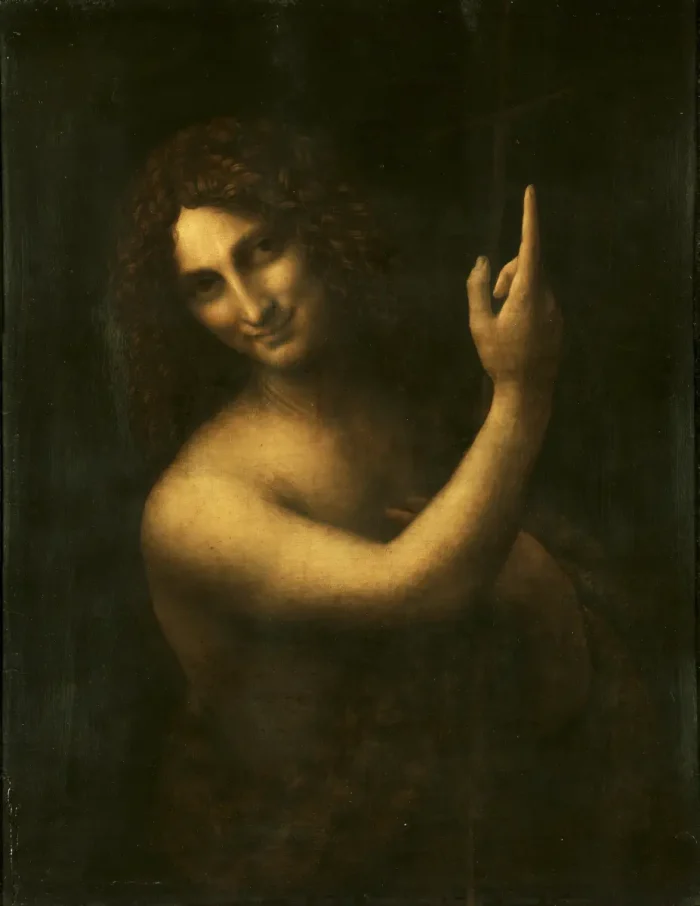
And it’s enough to look at both paintings to see the resemblance between Salai (or Gian Giacomo Caprotti) and Mona Lisa.
Also read: 100 Best One Liners from Movies
A Master, His Apprentice, and Five Centuries of Gossip
So were they lovers? Nobody knows, and I will not pretend to know otherwise.
Leonardo left no letters about his private life, no confessions, nothing. What we have is suggestive though: three decades under the same roof, a tender if exasperated nickname, the drawings, and rumors that circulated during his own lifetime.
Decades before Salai arrived, young Leonardo had been among the men anonymously accused of sodomy in Florence in 1476, but the charges were dropped for lack of witnesses.
Most modern biographers consider it likely that Leonardo was attracted to men, and Salai is the most frequently named candidate. But “likely” is the most we can say here.
But if this is true, it can also be true that Leonaro himself found the man fascinating and some of his features drifted into the most famous portrait ever painted stops sounding absurd and starts sounding human.
Artists put the people they obsess over into their work, consciously or not, and this could be one of the realities.
Mona Lisa: Salai vs Lisa Gherardini vs Da Vinci
Short of building a time machine and standing behind Leonardo’s easel in 1503, we will never get a signed and dated answer to this question.
What we can do is line the theories up and weigh them honestly. Salai’s case is laid out above, so let us give the other two their best shot.
Also read: 18 Amazing Abandoned Places on Earth
Lisa Gherardini: The Merchant’s Wife with the Paper Trail
The mainstream answer, and the one I find convincing, is Lisa Gherardini. Born in Florence in 1479, she was the daughter of an old family that had come down in the world, and at fifteen she married Francesco del Giocondo, a successful silk merchant more than twice her age.
Around 1503, Francesco commissioned a portrait of his wife. The traditional reading ties the timing to the birth of their second son and the purchase of a new family home, the kind of domestic milestones that got Florentine couples commissioning portraits.
Leonardo began work that autumn, as Vespucci’s note confirms, and then did the most Leonardo thing imaginable: he kept the painting.
He reworked it on and off for years, carried it with him when he moved to France at the invitation of King Francis I, and never delivered it to the man who had paid for it.
After Leonardo’s death in 1519, the picture entered the French royal collection, and it has belonged to France ever since.
This theory also explains the painting’s names without any wordplay at all. “Mona Lisa” comes from “monna,” a contraction of ma donna, meaning “my lady,” so the title simply means Lady Lisa.
“La Gioconda,” the Italian alternative, comes from her married name, del Giocondo, and doubles as a pun on the Italian word for “jocund” or “joyful,” which is also how the French title, La Joconde, came about.
The Self-Portrait Theory: Leonardo as His Own Muse
The idea that the Mona Lisa is Leonardo in disguise is also a circulating theory, and it has been revived in every generation since the painting became a global celebrity.
Its modern form rests on the work of Lillian Schwartz, a pioneering computer graphics artist who in 1987 digitally overlaid the Mona Lisa’s face with Leonardo’s red chalk self-portrait and found that the features aligned.
If the same face fits both images, the argument runs, the sitter must be the same person.
The interpretation, though, does not survive modern technology. The two portraits show people of very different ages, the overlay method is highly sensitive to small alignment choices, and the deeper objection is the same one that trips up the Salai comparison: an artist’s faces resemble each other because an artist has a style.
Today the self-portrait theory is largely rejected by specialists, kept alive by documentaries and by our collective appetite for the idea that the world’s most famous painting is a private joke.
So Where Does That Leave Salai?
Where we left him a few sections ago: with a determined champion, a claim about hidden letters, and no document from Leonardo’s lifetime.
The best thing the Salai theory has going for it is the fact that Salai really did sit for Leonardo, in works that really do share the Mona Lisa’s features.
The worst thing it has going for it is everything else.
If the question is whether Leonardo could have worked some of Salaì’s features into a portrait he reworked for over a decade, the honest answer is maybe; artists’ hands wander, and this artist’s attention wandered more than most.
If the question is whether the Mona Lisa is actually a portrait of a man, the honest answer is that the evidence does not come close to carrying that weight.