
The Scroll Of Taiwu is one of those games that makes you feel incredibly smart for five minutes… right before it hits you with a massive pan you can’t figure out at all.
At first glance, it looks like a martial arts RPG. Spend more than an hour with it, though, and you realize it’s actually an incrdibly deep sandbox that mixes wuxia progression systems, faction management, dynasty building, economics, relationship simulation, tactical combat, reincarnation mechanics, and enough layered systems to make most RPGs feel embarrassingly simple.
And if you jump in blind? You’ll probably get folded by mechanics you didn’t even know existed.
Here’s everything that actually matters if you want a strong start, without wasting your first dozen hours learning painful lessons the hard way, like I did.
First, Understand What Kind of Monster This Game Actually Is
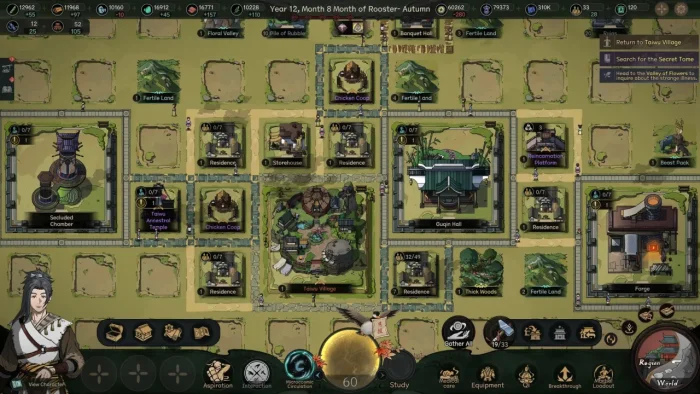
You start as essentially a nobody, but over time you’re building an entire faction while preparing future generations of heirs who inherit your knowledge after death. Unlike most RPGs where dying means reload screen, here death is basically part of the progression loop.
The heir system allows your successor – usually someone from your party – to inherit your cultivated knowledge, skills, and progression. If you enabled random heirs during setup, the game can even throw an unexpected successor at you.
Meanwhile, the world keeps moving whether you’re present or not.
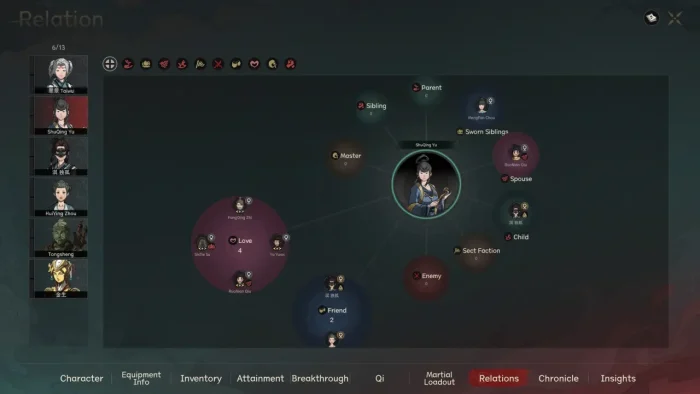
NPCs form relationships, fight, travel, train, marry, betray each other, and generally behave like they have their own agenda. It’s one of the rare RPGs where the world genuinely feels alive instead of waiting politely for the player to do something.
You’re also constantly expanding Taiwu Village, building your economy, managing family bloodlines, recruiting companions, and eventually preparing descendants that can become outright absurdly powerful.
Nearly every difficulty parameter can be customized. Enemy intelligence, world wealth, invasion frequency, optional Abyss modifiers – almost everything is adjustable, and most settings can be changed again whenever your current character dies.
Also read: NGU Idle: How to Unlock Titans
Character Creation Can Decide Whether Your First Run Sucks
The game does not tell you how important early choices are. For example, birth month determines your starting elemental alignment, and early on this matters far more than the game initially suggests.
The elemental setup works like this:
January-February = Wood
March = Earth
April-May = Fire
June = Earth
July-August = Metal
September = Earth
October-November = Water
December = Earth
If you already know which sect you’re planning to focus on, matching your birth element with that sect gives a noticeably smoother start.
Long-term, though, it doesn’t matter much.
Early game on higher difficulties? It absolutely matters.
Your moral standpoint matters too. Kind and Even are by far the safest picks. Just, Rebel, and especially Egoist tend to create unnecessary conflicts, and since constantly acting against your personality lowers mood, these alignments create problems fast.
Ignore The Yellow Heritage Tree Entirely
The heritage system offers three upgrade trees. One of them is basically bait – the yellow one.
The blue tree is arguably the strongest overall. It boosts core stats, can massively improve beauty, and gives you a childhood friend who conveniently spawns as an ideal early marriage candidate with decent talents and no terrible traits.
The poison resistance and longevity bonuses later in the tree are fairly mediocre, but the early stat bonuses are excellent.
Purple is the long-term investment tree. It improves martial learning speed, book comprehension, fine arts talents, and hereditary bonuses that pass down through future generations. This is dynasty-building territory.
Yellow? Skip it. It offers some early resources, a horse, materials, and eventually treasure. While it sounds nice, it’s nowhere near as valuable as hereditary bonuses that permanently strengthen your descendants.
Also read: BlazBlue Central Fiction Tier List
Difficulty Settings Matter More Than You Think
The default difficulty descriptions are slightly misleading.
Easy is basically story mode. Normal becomes trivial once you understand the systems. Hard forces you to actually engage with mechanics. Doom is where the game stops pretending to be friendly. Abyss modifiers add roughly another half-tier of difficulty.
So Hard + Abyss isn’t quite Doom, but Doom + Abyss is the game politely asking whether you hate yourself.
One overlooked setting is longevity. Setting shorter lifespans makes generations cycle faster, meaning more reincarnated NPCs begin appearing throughout the world. More reincarnations means more naturally gifted characters spawning, which can become very useful later.
The Tutorial Choices Aren’t Cosmetic
Early dialogue with your father looks harmless, but it isn’t. Here are the effects you get depending on what you answer:
- Choosing dialogue option 2 gives +10 to all martial arts.
- Option 3 gives +10 to fine arts.
- Staying silent gives +5 to both.
Then your father offers a martial art specialization. This determines your starting weapon, skill book, and permanently boosts talent in that martial discipline unless you’re already above 90 talent.
Also read: Super Auto Pets Tier List
Your First Map Has Some Ridiculously Valuable Loot
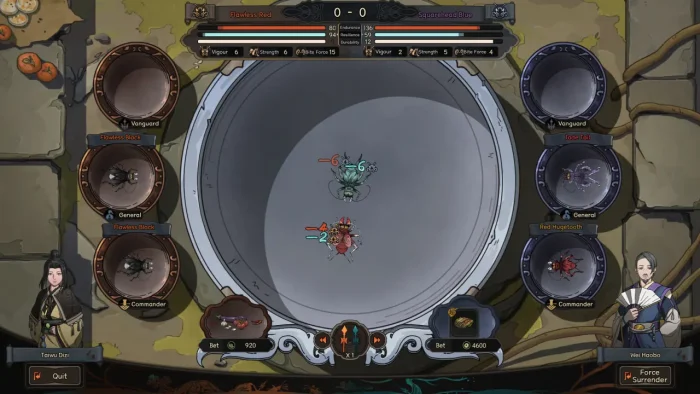
Before leaving the tutorial area, catch crickets whenever possible. Yes, crickets – it might sound like a bad idea or a waste of time, but they’re very OP later on.
Next, do the Monkey King adventure because you want three things from it: the monkey mount, Monkey Wine, and Peach hidden in the cave behind the boss.
These are Tier 1 items and incredibly valuable gift material when dealing with high-level NPCs later.
Hidden Village: Your First Big Decision Can Change The Entire Run
The second area introduces three recruitable characters, Ai Nu, Situ, and Yan Guo and there are some hidden mechanics here.
The character with highest intimacy joins through the main route. The character with lowest mood becomes demonized. Afterward, they appear as a hostile Tier 9 enemy you can defeat and rescue.
This means that you should be strategic with your choices. Situ is by far the strongest fighter. If she demonizes early on higher difficulty settings, fighting her while half-naked with starter gear is basically suicide.
Your safest route is usually recruiting Situ and Ai Nu. Situ can teach excellent early assassin sect techniques, while Ai Nu provides healing support.
Avoid talking much to Yan Guo if you want better odds of controlling who joins.
Also worth noting is that characters recruited through intimacy routes flip to their opposite alignment. Demon-route recruits keep original alignment. because apparently friendship changes people more than demonic possession.
Also read: Helldivers 2: How to Destroy the Fuel Silos
Combat Looks Simple Until You Learn Why You Keep Losing
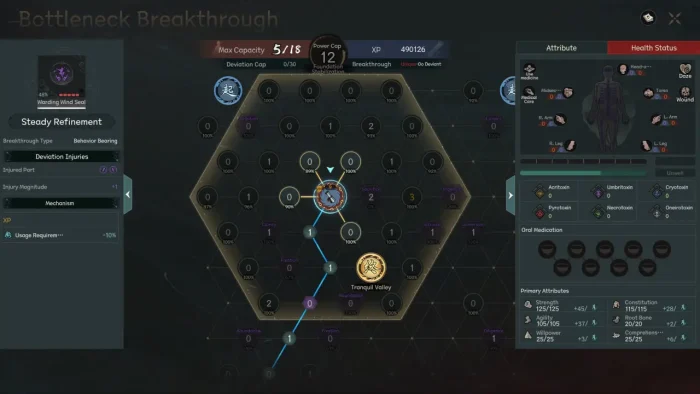
Combat in Taiwu is absurdly layered. There are three main damage systems:
- External damage (orange) uses Stance.
- Internal damage (purple) uses Inhale.
- Mind/Sound damage uses daze markers and often bypasses several normal combat mechanics entirely.
Poisons are split between three external poison types and three internal poison types. Then there are temporary wounds and permanent wounds. Temporary wounds carry severity levels from one to three stars. Permanent wounds can survive combat and eventually become actual lasting injuries visible in the Health interface.
Accuracy Is Secretly Your Damage Multiplier
A lot of players misunderstand hit chance, and you should know that accuracy affects damage, not just whether attacks land or not.
There are three primary offensive stats: Force, Precision, Dexterity.
These are countered by: Resistance, Parry, Dodge.
Sound attacks instead use Sway versus Poise, bypassing parts of normal defense calculations. The bigger your accuracy advantage over enemy defense, the more damage you inflict. This means boosting accuracy is effectively increasing DPS. Likewise, stacking defenses directly reduces incoming damage.
Also read: How to play Randoms in Helldivers 2
Weapon Mechanics Are Much More Complicated Than Swinging Things
Every weapon cycles through six combat styles in a clockwise rotation. Successful attacks generate style tokens. skills consume not only energy but also style tokens, higher-level attacks require more style resources.
You can occasionally force style-specific attacks to deliberately generate the token you need.
Each weapon also has attack interval speed: lower interval means faster attacks (obviously)
Range mechanics matter heavily too. Stepping outside enemy weapon range right before impact can avoid attacks completely.
Skills modify weapon range further. For example: A knife with 3.0–5.0 range using a skill with -0.5/+1.5 creates effective range of 2.5–6.5. This makes movement timing incredibly important.
Defensive skills cast faster than offensive ones, giving defenders reaction opportunities.
Healing Is More Flexible Than Most Players Realize
Healing works both in and out of combat. Inside combat, healing and detoxing require cast time. Healing amount and usage frequency scale with Medicine skill. Detox scales with Toxicology.
Only active companions – up to three designated battle companions – can heal or detox you during combat.
Outside combat, the Medical interface allows anyone in your team to heal others. You can also visit doctors in towns or seek healing from sects specializing in medicine or detoxification.
Also read: GBF Relink: Best Ferry Build
Sect Progression Is The Real Power Curve
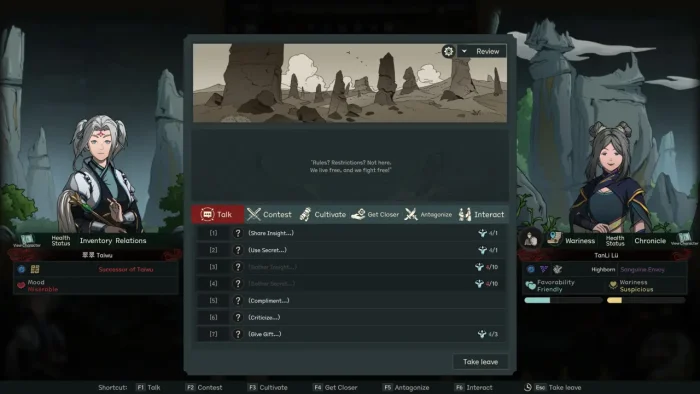
Most powerful skills come from sects. To learn techniques, you first need support from sect members and requirements scale by tier:
- Tier 9 skills require 10% support.
- Tier 8 needs 20%.
- Tier 7 requires 30%.
- And so on.
After gaining support, NPCs can trade skill books for prestige. These books allow skill customization through Orthodox (blue) and Heterodox (red) modifiers.
Skills aren’t immediately useful once obtained. You need to: read chapters, equip skills, fully complete books, then Breakthrough.
Martial books contain complete and incomplete chapters affecting reading difficulty.
Breakthrough choices determine whether skills gain Orthodox or Heterodox special effects.
Fine Arts books work differently and each only has 5 chapters that you have to read.
Abuse The Third Map Or Regret It Later
The third tutorial village introduces one of the strongest early exploits.
When you arrive, do not leave immediately with the coach! Time progresses as demons approach, so stay until the final possible moment.
Immediately gift your rare Monkey Wine or Peach to either the mayor or their strongest martial arts companion (prefer Kind-aligned NPCs when possible). Raise relationship to Familiar, then Intimate, then become sworn siblings.
Now exploit the teaching system and have them teach three Tier 9 skills. Read one chapter quickly, then return for three more.
Repeat until learning every available Tier 9 and Tier 8 technique. This step is absolutely critical on Hard or Doom difficulty.
Then comes the strange part. After leaving, the demonized village falls and with it, your sworn sibling dies too.
When sworn siblings die, you inherit part of their belongings, which often means receiving mid-to-high tier gear and skill books. Congratulations! You just profited from friendship.
Also read: Disney Dreamlight Valley: How to Get Fabric and Cotton
Building Your Economy Is Shockingly Easy
Early economy boils down to one simple rule: build production first.
Taiwu Village starts packed with collectible resources. Clear weeds, ruins, and stones and avoid removing blue-named resources unless duplicates exist.
Priority order: Expand warehouse immediately, otherwise excess resources get wasted. Then, build resource production structures matching your village resources. Assign villagers to operate buildings.
If missing resources, dispatch villagers to world map tiles with better yields.
For money and prestige, early setup works best with a Training Hall. Two or three Escort Agencies for income, one Guesthouse for prestige generation which fuels travel and skill trading.
Also remember villagers can die, which means empty workstations quietly kill production if you forget to reassign workers (Because apparently labor shortages exist even in wuxia fantasy).
The Entire Game Eventually Becomes Eugenics Simulator
Family building is absurdly deep here and I am sure it’s one of the things you will appreciate the most.
Children inherit stats based roughly around parental averages, bad partner stats drag offspring downward, talents can be boosted beforehand using the Ancestral Hall.
You can improve both your partner’s talents before conception, ten improve children later. Then improve your children’s partners. This compounds over generations.
Birth traits work similarly: if both parents share the same trait, inheritance chance skyrockets and even opposite-value traits can combine favorably.
Example:
+30 comprehension trait plus partner with -10 comprehension can still average positively and improve inheritance odds.
Strong traits worth targeting include: cast speed bonuses, long limbs, all-stat boosts, Qi bonuses, penetration bonuses, recovery speed bonuses.
Note: Sects often contain stronger partner candidates.
Another option is obtaining the Loyal Servant from the Fu Long sect after reaching 30% regional deeds. The servant carries a highly inheritable loyalty trait.
Partner traits can also be modified through Jade Maiden Sect services at 50% regional deed cost.
Alignment changes are possible through the Eminent Monk aspiration using Buddhist debates.
Final Thoughts
My final thought (or just reality-sharing) is that you are going to fail your first run. That’s normal – The Scroll Of Taiwu is not designed around quick mastery.
The game rewards system knowledge more aggressively than almost any RPG I’ve played, so learn sect progression early, understand combat accuracy, abuse the tutorial maps, build economy first, breed absurd descendants, catch suspiciously overpowered crickets and most importantly:
When the game gives you a mechanic that looks harmless… Assume it secretly controls half the progression system.
Do you have additional tips and tricks for fellow players? Let us all know in the comments down below.